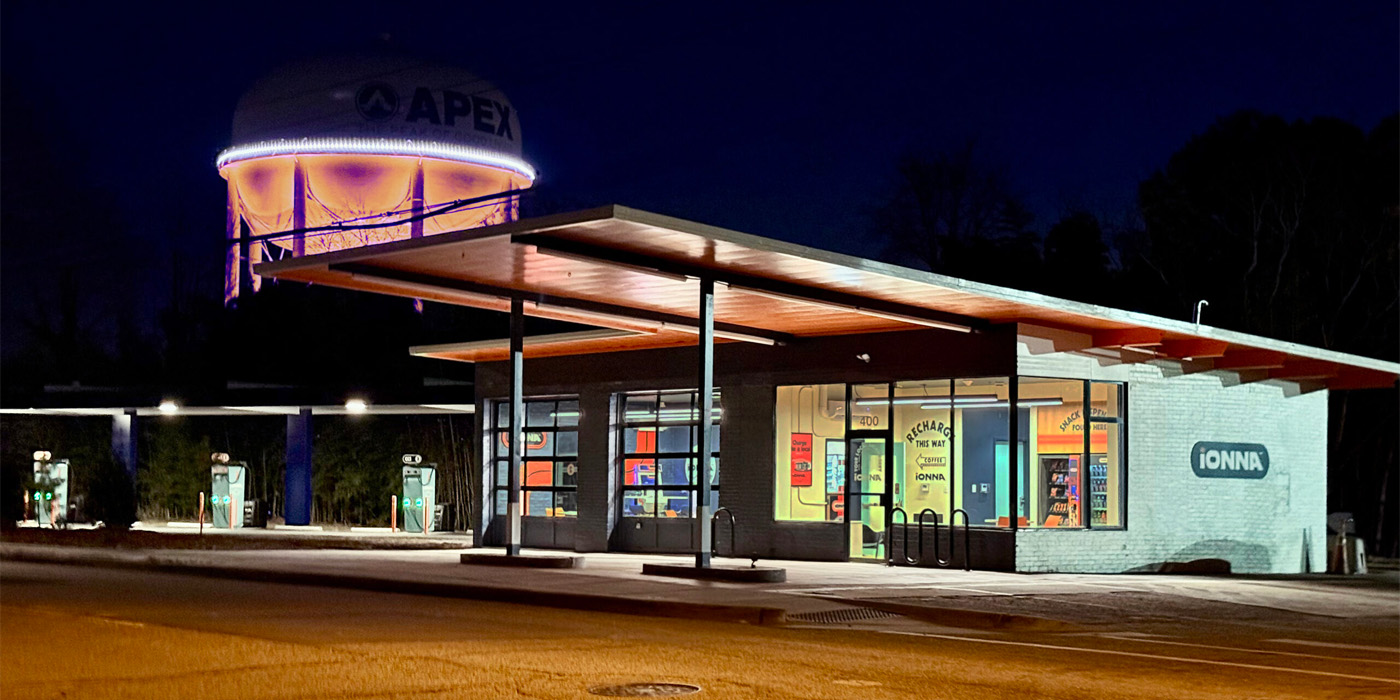
How fast can your EV charge?
IONNA Rechargeries deliver up to 400 kW, and your EV decides how much of that it takes. A typical fast charge from about 20% to 80% takes 20 to 40 minutes, depending on the car, its battery size, the temperature and how much charge it starts with.
Peak power at every IONNA charging dispenser
In about 20 to 40 minutes
Sets the speed, not the dispenser
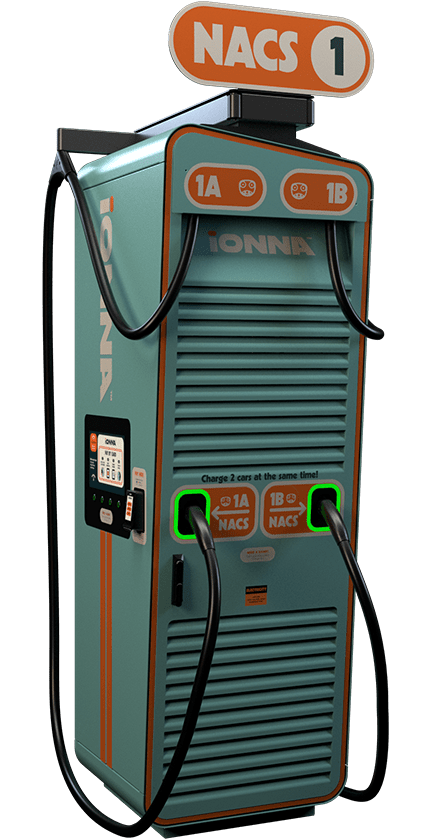
What decides how fast your EV charges
The EV charger sets the ceiling on charging speed, but your EV decides how close it gets to that. Battery size, how full it is, and how warm it is all move the number.
That's the ceiling, and it's the same at every bay. Whichever one you pull into, the dispenser isn't what's setting your speed.
Your EV’s maximum rate
Every EV has a built-in maximum charging speed it can accept, and no charger can push past it. Most EVs ask for less than 400 kW, so your car is usually the limit rather than the dispenser.
How full the battery is
Charging is fastest when the battery is low and slows down as it fills. That’s why the 20% to 80% window is the quickest stretch, and why arriving closer to 20% gets you the highest speeds.
Battery temperature
A cold battery accepts power more slowly. Preconditioning on your way to the Rechargery warms it up, so you arrive closer to its ideal temperature. Many EVs do it automatically when you set your destination.
How to charge your EV faster
These practices make more difference to your charging speed than anything at the charger.
-
Precondition on the way
Preconditioning warms the battery so you arrive closer to its ideal temperature, allowing your EV to accept a faster charge. Many EVs do it automatically when you set the Rechargery as your destination.
-
Arrive with a low battery
Pull in at around 20%. Charging is quickest when the battery is low, so you spend less time plugged in.
-
Stop at 80% and go
Charging slows sharply above 80%, so the climb from there to full can take as long as everything before it. If time matters more than the last few percent, unplug and hit the road, we’ll be there for your next charge.
Why EV charging slows after 80%
Your EV tapers charging power as the battery fills, to manage heat and protect the pack. That slowdown is called tapering, and it’s by design, not a fault with the dispenser.
How fast it charges
Where the time goes
- 0 to 20%
Power climbs to its peak as the session gets going.
- 20 to 80%
The fastest stretch, and where most of your range arrives.
- 80 to 100%
Your EV tapers power to protect the battery. This stretch takes the longest.
Both diagrams are illustrative. The curve carries no kW figures and the bar carries no minutes, because your car, its battery and the weather decide both.
In a hurry? Unplug at 80%
The last stretch takes as long as everything before it. If you are watching the clock, that is the moment to go.
No rush? Fill it right up
Nothing waiting on you, or got a long stretch ahead? Take it to 100% and set off with a full battery.
EV charging speed FAQs
Quick answers about how fast an EV charges at an IONNA Rechargery.
What does 400 kW charging mean for my EV?
Charging speed is measured in kilowatts (kW), and the higher the number, the faster a charger can deliver power. IONNA chargers deliver up to 400 kW, shared between two cars to give each one what it needs. Your EV sets its own top speed, so how fast you charge depends on your car.
Why am I not getting the charger’s maximum speed?
Your car sets the rate, not the charger. It asks for power based on its own max charging speed, how full the battery already is, and how warm the battery is.
Most EVs peak early in a session and ease off as the battery fills. If it's cold out, consider preconditioning your battery to the ideal temperature so the cold isn't what's slowing you down.
Why does EV charging slow down after 80%?
EV batteries charge more slowly as they fill up to protect the battery. That is why charging often slows down after about 80%. On a road trip, charging to around 80% and getting back on the road is usually the quickest option.
Why does my EV charge slower in cold weather?
Batteries charge more slowly when they are cold. Many EVs warm up the battery on the way to the Rechargery when you use the car's built in navigation. That way, you can charge faster when you arrive.
Is DC fast charging bad for my EV battery?
Your car manages the charging speed to look after its battery. For everyday charging tips, check your automaker's guidance.
What is the difference between kW and kWh?
kW is speed and kWh is amount. Kilowatts measure how fast energy flows into your battery, and kilowatt-hours measure how much energy you actually got.
Dispensers are rated in kW, so a higher number means a faster charge. You pay by the kWh, plus tax, for the energy that reaches your battery.
How long does it take to fast charge an EV at IONNA?
It depends on your EV. Most EVs charge from about 20% to 80% in 20 to 40 minutes at an IONNA Rechargery, depending on the car, its battery size, the temperature and how much charge it starts with. IONNA chargers deliver up to 400 kW, so your EV can charge as fast as it is able to.
More about charging at IONNA
The practical bits, before you go.
Ready for your fastest charge?
Find your local Rechargery and pull in. We’ll take it from there.

